

Results of Previous Elections to the Russian State Duma
The election law adopted for the 1993 Duma election stipulated half the 450 Duma members were elected by a party-list system of proportional representation (PR) and half were elected as individual representatives from single-member districts (SMD). Every Russian voter thus received two different ballots. The proportional representation ballot compelled each voter to endorse an electoral organization or vote against all of them. By contrast, the SMD ballot required a voter to endorse an individual, whose party affiliation, if any, could not be given on the ballot.
In order to nominate a list of candidates in the PR ballot, a party or electoral organization had to gather 100,000 signatures from the electorate, of which no more than 15 per cent could be from any one region or republic. The method used to calculate the number of seats won by each party was the Hare method, with a threshold of 5.0 per cent of the valid vote, including votes cast against all, but excluding invalid ballots. To secure a place on an SMD ballot candidates had to gather the signatures of at least 1.0 percent of the constituency electorate. The winner in each SMD contest was simply the candidate with the most votes, regardless of the number of votes cast against all.
12 December 1993
| Votes, % | Seats | ||||||
|---|---|---|---|---|---|---|---|
| List | SMD | List | SMD | Total,% | |||
| Valid Votes | 50.6 | 50.6 | |||||
| Invalid Votes | 3.7 | 4.0 | |||||
| Total Votes (% of electorate) | 54.3 | 54.6 | |||||
| 1 | Liberal Democratic Party | 21.4 | 2.7 | 59 | 5 | 14.3 | |
| 2 | Russia’s Choice | 14.5 | 6.3 | 40 | 30 | 15.6 | |
| 3 | Communist Party | 11.6 | 3.2 | 32 | 16 | 10.7 | |
| 4 | Women of Russia | 7.6 | 0.5 | 21 | 2 | 5.1 | |
| 5 | Agrarian Party of Russia | 7.4 | 5.0 | 21 | 12 | 7.3 | |
| 6 | Yabloko | 7.3 | 3.2 | 20 | 3 | 5.1 | |
| 7 | Russian Unity and Concord | 6.3 | 2.5 | 18 | 1 | 4.2 | |
| 8 | Democratic Party of Russia | 5.1 | 1.9 | 14 | 1 | 3.3 | |
| 9 | Movement for Democratic Reforms | 3.8 | 1.9 | 0 | 4 | 0.9 | |
| 10 | Civic Union | 1.8 | 2.7 | 0 | 1 | 0.2 | |
| 11 | Future of Russia | 1.2 | 0.7 | 0 | 1 | 0.2 | |
| 12 | Cedar | 0.7 | 0.5 | 0 | 0 | 0 | |
| 13 | Dignity and Charity | 0.7 | 0.8 | 0 | 2 | 0.4 | |
| 35 | Independents | — | 45.2 | — | 146 | 32.5 | |
| 36 | Against all | 3.9 | 14.8 | — | — | — | |
| Others | 0.0 | 0.7 | 0 | 0 | 0 | ||
| Invalid ballots | 6.8 | 7.4 | |||||
| Total | 100 | 100 | 225 | 224* | 100 | ||
* One seat left vacant in Chechnya due to political situation.
17 December 1995
The election law adopted for the 1995 election was similar to that adopted for the 1993 election, with the following minor modifications. First, to secure a place on the PR ballot, parties had to have registered with the Ministry of Justice no later than six months before the election, and the number of signatures they had to gather rose from 100,000 to 200,000. Second, invalid votes were now included in the calculation of the 5.0 percent threshold. Third, on the SMD ballot, party endorsements of candidates were indicated.
| Votes, % | Seats | ||||||
|---|---|---|---|---|---|---|---|
| List | SMD | List | SMD | Total, % | |||
| Valid Votes | 64.4 | 62.9 | |||||
| Invalid Votes | 1.3 | 1.4 | |||||
| Total Votes (% of electorate) | 65.7 | 64.3 | |||||
| 3 | Communist Party | 22.3 | 12.6 | 99 | 58 | 34.9 | |
| 1 | Liberal Democratic Party | 11.2 | 5.4 | 50 | 1 | 11.3 | |
| 14 | Our Home Is Russia | 10.1 | 5.5 | 45 | 10 | 12.2 | |
| 6 | Yabloko | 6.9 | 3.2 | 31 | 14 | 10.0 | |
| 4 | Women of Russia | 4.6 | 1.0 | 0 | 3 | 0.7 | |
| 15 | Communists of the USSR | 4.5 | 1.8 | 0 | 1 | 0.2 | |
| 16 | Congress Russian Communities | 4.3 | 2.9 | 0 | 5 | 1.1 | |
| 17 | Workers’ Self-Government | 4.0 | 0.7 | 0 | 1 | 0.2 | |
| 2 | Russia’s Choice | 3.9 | 2.6 | 0 | 9 | 2.0 | |
| 5 | Agrarian Party of Russia | 3.8 | 5.9 | 0 | 20 | 4.4 | |
| 18 | Great Power | 2.6 | 0.6 | 0 | 0 | 0 | |
| 19 | Forward Russia! | 1.9 | 1.5 | 0 | 3 | 0.7 | |
| 21 | Union of Labor | 1.6 | 0.9 | 0 | 1 | 0.2 | |
| 22 | Pamfilova–Gurov–Lysenko Bloc | 1.6 | 0.7 | 0 | 2 | 0.4 | |
| 20 | Power to the People! | 1.6 | 1.9 | 0 | 9 | 2.0 | |
| 12 | Cedar | 1.4 | 0.4 | 0 | 0 | 0 | |
| 23 | Ivan Rybkin Bloc | 1.1 | 1.5 | 0 | 3 | 0.7 | |
| 24 | Stanislav Govorukhin Bloc | 1.0 | 0.7 | 0 | 1 | 0.2 | |
| 7 | Russian Unity and Concord | 0.4 | 0.4 | 0 | 1 | 0.2 | |
| Independents | — | 31.2 | — | 77 | 17.1 | ||
| Against all | 2.8 | 9.6 | — | — | — | ||
| Others | 6.6 | 6.6 | 0 | 6* | 0 | ||
| Invalid ballots | 1.9 | 2.3 | |||||
| Total | 100 | 100 | 225 | 225 | 100 | ||
* Six small parties winning one single-member seat each.
19 December 1999
The election law adopted for the 1999 election showed further tinkering with the mixed member electoral system of previous years. To secure a place on the ballot, parties had to have registered with the Ministry of Justice one year before the election instead of six months. As an alternative to gathering 200,000 signatures, they had the option of paying a deposit of just over two million roubles, returnable if the party won at least 3.0 percent of the list vote. In order to increase proportionality, the law provided that if parties reaching the five per cent threshold got in total 50 per cent or less of the vote, parties with at least 3.0 per cent of the vote would also win seats by declining numbers of votes up to the point at which the total share of vote exceeded 50 per cent. However, if after this procedure the parties winning seats still had less than 50 per cent of the vote, the election was to be deemed invalid. In the SMD ballots, if votes cast against all exceeded the votes of each candidate, a repeat election had to be held within four months. As a result, repeat elections had to be held in eight districts. Finally, as an alternative to gathering signatures in support of their nomination, SMD candidates were also given the option of paying a deposit of 83,490 roubles, returnable if s/he won at least 5.0 percent of the district vote.
| Votes, % | Seats | ||||||
|---|---|---|---|---|---|---|---|
| List | SMD | List | SMD | Total, % | |||
| Valid Votes | 60.5 | 60.3 | |||||
| Invalid Votes | 1.2 | 1.3 | |||||
| Total Votes (% of electorate) | 61.7 | 61.6 | |||||
| 3 | Communist Party | 24.3 | 13.4 | 67 | 46 | 25.1 | |
| 25 | Unity | 23.3 | 2.1 | 64 | 9 | 16.2 | |
| 26 | Fatherland–All Russia | 13.3 | 8.6 | 37 | 31 | 15.1 | |
| 27 | Union of Right Forces | 8.5 | 3.0 | 24 | 5 | 6.4 | |
| 1 | Liberal Democratic Party | 6.0 | 1.5 | 17 | 0 | 3.8 | |
| 6 | Yabloko | 5.9 | 5.0 | 16 | 4 | 4.4 | |
| 15 | Communists of the USSR | 2.2 | 0.7 | 0 | 0 | 0 | |
| 4 | Women of Russia | 2.0 | 0.5 | 0 | 0 | 0 | |
| 28 | Party of Pensioners | 1.9 | 0.7 | 0 | 1 | 0.2 | |
| 14 | Our Home Is Russia | 1.2 | 2.6 | 0 | 7 | 1.6 | |
| 16 | Congress Russian Communities | 0.6 | 0.7 | 0 | 1 | 0.2 | |
| 31 | Nikolaev–Fedorov Bloc | 0.6 | 1.0 | 0 | 1 | 0.2 | |
| 29 | For Citizens’ Dignity | 0.6 | 0.2 | 0 | 0 | 0 | |
| 30 | Movement in Support of the Army | 0.6 | 0.7 | 0 | 2 | 0.4 | |
| 32 | Russian People’s Union | 0.4 | 1.1 | 0 | 2 | 0.4 | |
| 33 | Russian Socialist Party | 0.2 | 1.0 | 0 | 1 | 0.2 | |
| 34 | Spiritual Heritage | 0.1 | 0.9 | 0 | 1 | 0.2 | |
| 12 | Cedar | — | 0.2 | — | 0 | 0 | |
| Independents | — | 41.7 | — | 114 | 25.3 | ||
| Against all | 3.3 | 11.6 | — | — | — | ||
| Others | 2.9 | 0.6 | 0 | 0 | 0 | ||
| Invalid ballots | 1.9 | 2.2 | |||||
| Total | 100 | 100 | 225 | 225 | 100 | ||
Duma Voting behaviour: 1999
7 December 2003
The election law adopted for the 2003 election retained the mixed member system, but saw the creation of an uneven playing field for new and established parties. In June, 2001, the Duma approved a Kremlin-backed law designed to reduce the number of parties appearing on the ballot by establishing demanding organizational criteria for registration with the Ministry of Justice, including at least 10,000 members and branches with a minimum of 100 members each in at least 45 of the country's then 89 regions, and no less than 50 members in each of the remaining branches (an amendment to the law in December 2004 increased these membership requirements five-fold, to 50,000 members, with branches of 500 members each in 45 regions and no less than 250 members in the remaining branches). Those parties which were able to meet these criteria were exempt from the requirement to collect 200,000 signatures or pay a deposit equal to 37.5 million roubles. The electoral deposit required of SMD candidates as an alternative to collecting signatures also rose to 900,000 roubles, more than ten times the amount in 1999.
437SEATS WON IN DUMA: FINAL RESULTS
Central Electoral Commission, 2003
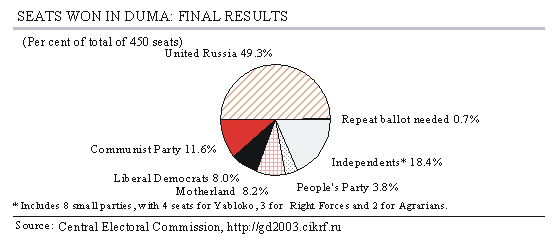
438
PERCENTAGE SHARES OF LIST VOTE: FINAL RESULTS
Central Electoral Commission, 2003
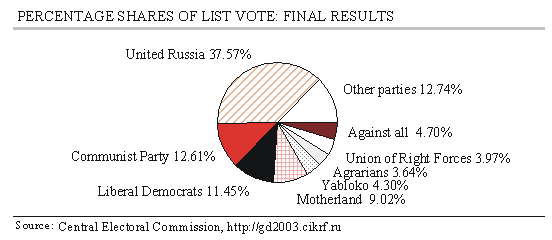
Detailed results: 2003
| Votes, % | Seats | ||||||
|---|---|---|---|---|---|---|---|
| List | SMD | List | SMD | Total, % | |||
| Valid Votes | 54.8 | 54.3 | |||||
| Invalid Votes | 0.9 | 1.1 | |||||
| Total Votes (% of electorate) | 55.7 | 55.4 | |||||
| 29 | United Russia | 37.6 | 23.2 | 120 | 102 | 49.3 | |
| 3 | Communist Party | 12.6 | 10.8 | 40 | 12 | 11.6 | |
| 1 | Liberal Democratic Party | 11.5 | 3.1 | 36 | 0 | 8.0 | |
| 30 | Motherland | 9.0 | 2.9 | 29 | 8 | 8.2 | |
| 6 | Yabloko | 4.3 | 2.6 | 0 | 4 | 0.9 | |
| 27 | Union of Right Forces | 4.0 | 2.9 | 0 | 3 | 0.7 | |
| 5 | Agrarian Party of Russia | 3.6 | 1.7 | 0 | 2 | 0.4 | |
| 28 | RPP-PSS: Pensioners– Fairness | 3.1 | 0.5 | 0 | 0 | 0 | |
| 31 | PVR-RPZh: Rebirth–Party of Life | 1.9 | 2.6 | 0 | 3 | 0.7 | |
| 32 | People's Party | 1.2 | 4.4 | 0 | 17 | 3.8 | |
| 33 | Conceptual Party Unity | 1.2 | 0.0 | 0 | 0 | 0 | |
| 34 | New Course: Automobile Russia | 0.8 | 0.4 | 0 | 1 | 0 | |
| 12 | Greens | 0.4 | 0.1 | 0 | 0 | 0 | |
| 36 | Development of Enterprise | 0.4 | 0.4 | 0 | 1 | 0 | |
| 37 | Great Russia-Eurasian Union | 0.3 | 0.8 | 0 | 1 | 0 | |
| 15 | Communist Workers | — | 0.1 | — | 0 | 0 | |
| Others | 1.7 | 2.1 | 0 | 0 | 0 | ||
| Independents | — | 26.8 | — | 68 | 15.1 | ||
| Against all | 4.7 | 12.9 | — | 3 | 0.7 | ||
| Invalid ballots | 1.6 | 2.1 | |||||
| Total | 100 | 100 | 225 | 225 | 100.0 | ||
Duma Voting behaviour: 2003
Reasons for List Party Vote
Social Structure and Voting
For further details of Russian elections under the mixed-member electoral system, see Rose and Munro, Elections and Parties in New European Democracies (Washington, DC: CQ Press, 2003), chapter 16.
2 December 2007
FINAL RESULT OF THE DUMA ELECTION, 2 DECEMBER 2007 |
||||
|
|
|
|
|
Electorate |
109,145,517 |
% |
|
|
Valid Votes |
68,777,136 |
63.01 |
|
|
Invalid Votes |
759,929 |
0.70 |
|
|
Total Votes |
69,537,065 |
63.71 |
|
|
|
Votes |
% |
Seats |
% |
United Russia |
44,714,241 |
64.30 |
315 |
70.0 |
Communist Party |
8,046,886 |
11.57 |
57 |
12.7 |
Liberal Democrats |
5,660,823 |
8.14 |
40 |
8.9 |
Fair Russia |
5,383,639 |
7.74 |
38 |
8.4 |
Agrarian Party |
1,600,234 |
2.30 |
0 |
- |
Yabloko |
1,108,985 |
1.59 |
0 |
- |
Civic Strength |
733,604 |
1.05 |
0 |
- |
Union of Right Forces |
669,444 |
0.96 |
0 |
- |
Patriots of Russia |
615,417 |
0.89 |
0 |
- |
Party of Social Fairness |
154,083 |
0.22 |
0 |
- |
Democratic Party of Russia |
89,780 |
0.13 |
0 |
- |
Source: Data from the Russian CEC protocol on the results of the elections to the State Duma of the Federal Assembly, http://www.vybory.izbirkom.ru, accessed 10.1.08 |
|
|||
NB: Seats are assigned by the largest remainder method to the lists of parties winning a minimum of 7.0 percent of the national vote.
Election Assessments 2007
Duma Voting behaviour: 2007
THE CHANGE IN SEATS |
||||
In the past, deputies elected to the Duma could their allegiance in parliament. Under current legislation, any deputies changing their party allegiance automatically forfeit their seats, which are given to the next person in the list of their original party. They may, however, quit their party and continue to sit as independents. The change of seats after the 2007 Duma election is as follows: |
||||
Seats: |
On election: |
As of: |
On election: |
Change since: |
|
07-Dec-03 |
01-Oct-07 |
02-Dec-07 |
Dec-03 |
United Russia |
222 |
303 |
315 |
93 |
Communists |
52 |
47 |
57 |
5 |
Liberal Democrats |
36 |
30 |
40 |
4 |
Fair Russia |
37 |
32 |
38 |
1 |
Motherland-People's Will-SEPR |
0 |
8 |
-- |
0 |
Minor parties |
32 |
- |
-- |
-32 |
Independents |
68 |
24 |
-- |
-68 |
Total |
(447*) |
(444**) |
-450 |
-- |
NB: *Three seats remained vacant after the 2003 Duma election due to the requirement that the candidate with the most votes must win more votes than were cast "against all". The "against all" vote no longer exists. |
||||
**Six seats were vacant in the Duma by 1 October 2007. |
||||
To compare with Duma alignments in the past, see Duma parties 1995-2003 |
||||
United Russia (Edinaya Rossiya ). Party list headed by President Putin during the 2007 election campaign, and endorsed by him in 2003. The party was created in December 2001 by the merger of Unity (Edinstvo), founded by government leaders in October 1999, with Fatherland-All Russia (Otechestvo-Vsya Rossiya, OVR), a rival in the 1999 elections. United Russia is formally led by Interior Minister Boris Gryzlov. Sergei Shoigu, minister for emergency situations and civil defence, Moscow mayor Yuri Luzhkov and Tatarstan president Mintimer Shaimiev, former OVR leaders, are co-chairs.
Communist Party, KPRF (Kommunisticheskaya Partiya Rossiiskoi Federatsii). Founded 1993. Leader: Gennady Zyuganov. Successor to the Communist Party of the Soviet Union. Won the most seats in the 1995 and 1999 Duma elections. .
Liberal Democratic Party of Russia, LDPR (Liberalno-Demokraticheskaya Partiya Rossiskoi Federatsii). Founded 1990. Led by maverick nationalist Vladimir Zhirinovsky.
Fair Russia. (Spravedivya Rossiya). Formed 2006 by the merger of Motherland People's Patriotic Union (Rodina Narodno-patriotichesky soyuz) with the Party of Pensioners and the Party of Life. Fair Russia is led by the Speaker of the Federation Council Sergei Mironov. Motherland had its origins in late August 2003 when more than 30 organizations came together under the leadership of academician Sergei Glazyev and journalist Dmitry Rogozin. Glazyev and Rogozin quarrelled over whether to contest the 2004 presidential election. Subsequently the Duma fraction split into two groups, the People's Patriotic Union giving rise to Fair Russia, and the People's Will faction, which did not contest the 2007 election.
Two liberal parties which formed separate blocs in previous Duma elections failed to clear the 7.0% barrier in 2007, just as they failed to clear to 5.0% barrier in 2003. They remain extra-parliamentary parties:
- Union of Right Forces, SPS (Soyuz Pravykh Sil). Founded in 1999. A pro-market party led by Nikita Belykh alongside Boris Nemtsov, former First Deputy Prime Minister in the Chernomyrdin cabinet. All three SPS deputies elected in single-member districts in 2003 had joined United Russia by the opening of the Duma.
- Yabloko.Founded 1993. Leader: Grigory Yavlinsky. Pro-market party which criticized the economic reforms of the 1990s. By the opening of the Duma in December 2003, one Yabloko deputy elected in a single-member district had joined United Russia and the remaining three were independents.
Top of Page